 +
+
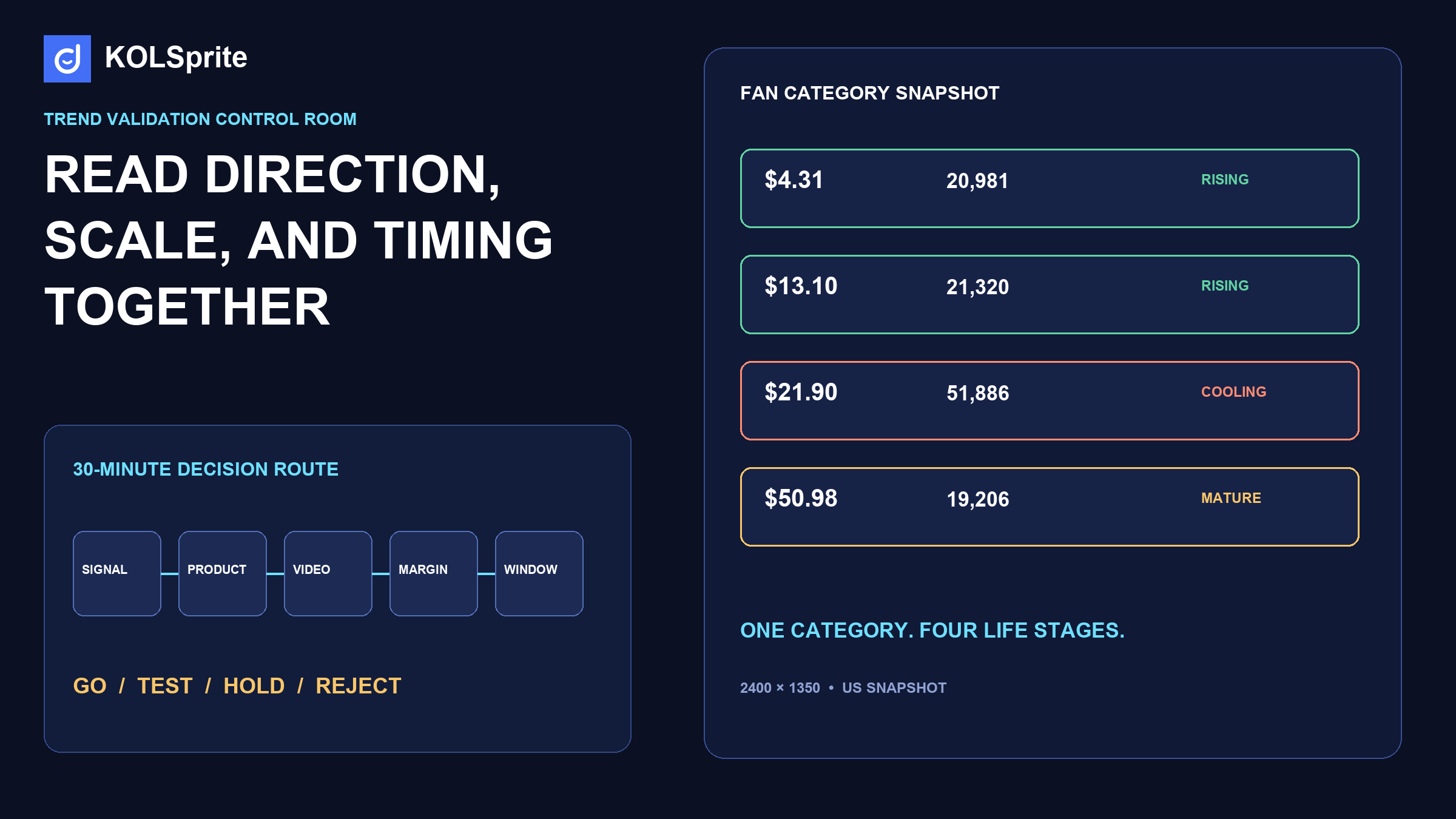
TikTok trend discovery should produce a timed decision, not a list of exciting hashtags. Ecommerce teams need to know whether a signal is early, broad, and profitable enough to test. This guide gives Amazon, Shopify, and TikTok Shop sellers a six-signal route. A fan-category snapshot shows fast growth and steep decline at the same time. You will then build a go, test, hold, or reject choice around product fit, videos, creators, margin, season, and operations.
Use a trend as a lead. Confirm it with several relevant products, recent videos, more than one creator, clear buyer problems, workable economics, and a window your inventory can meet. A rising percentage without a stable base can mislead you. A falling mature product can still sell well. Direction and scale must be read together.
A hashtag can rise because of entertainment, weather, news, a campaign, or one large creator. A product record can rise because the prior period was tiny. Search demand can grow while the seller’s category is already crowded. These signals are useful, but they do not answer the same question.
TikTok Shop's official Campaign Trends guidance describes trend context, performance, and lifecycle as seller inputs. That is a useful discovery layer. A seller still needs to test the exact product, price, timing, content, and margin before buying stock.
The decision comes before the data collection. The team may be choosing a product, timing inventory, planning content, or finding creators. An inventory decision needs a product-level signal and a delivery window. A general topic trend is not enough.
| Signal | What it can tell you | What it cannot prove |
|---|---|---|
| Search and hashtag direction | Language and topic attention. | Product demand or profit. |
| Product records | Price, recent public sales fields, growth, supply. | Your landed margin or future demand. |
| Video records | Proof formats, audience questions, content supply. | Causal sales or reuse rights. |
| Creator spread | Whether the story extends beyond one account. | Audience authenticity or campaign result. |
| Seller economics | Whether demand can produce contribution. | Whether creative will work. |
| Operating window | Whether stock and content can arrive in time. | How long the trend will last. |
A product with 20,000 recent units and negative growth may be cooling from a large base. A product with 200 units and 1,000% growth may be rising from almost nothing. The same card should show the current level, prior level, direction, and time window. Growth alone cannot rank the opportunity.
Then check whether the products are truly comparable. “Fan” can include handheld, waist-clip, neck, camping, solar-hat, and tower products. Each has different buyers, prices, proof, seasons, and shipping burdens.
KOLSprite connects product, video, shop, creator, and topic research so a broad signal can be narrowed to exact opportunities. Register for a three-day trial membership.
Start a three-day KOLSprite trial
In a scoped KOLSprite MCP US product search on August 5, 2026, a compact handheld fan priced at $4.31 showed 20,981 units in the 30-day field and a very large positive growth rate. Another handheld fan priced at $13.10 showed 21,320 units and positive growth. Both records had more than 100 linked videos or close to that level.
At the same time, a mature handheld fan priced at $21.90 showed 51,886 units in the 30-day field but a negative growth field. A solar fan hat and several wearable or camping fans also showed meaningful current units with sharp negative direction. A newer handheld product showed more modest positive growth.
This is what real trend research often looks like: not one arrow, but several product life stages. Low-price newcomers may be accelerating. Established leaders may still sell far more while cooling. Seasonal items may be leaving their strongest window. The category can be active without every product being early.
Research note: one scoped KOLSprite US product-search page for “neck fan,” accessed August 5, 2026. The result contained several fan formats. Public fields, prices, and availability can change. Growth can be sensitive to the comparison base. No claim is made about total market demand, profit, or future performance.
Signal: active demand across several fan formats, with both rising newcomers and declining mature items. Opportunity: test a compact use case with clear proof and manageable shipping. Risk: late-season inventory and growth percentages inflated by small prior periods. Decision: run a short content and landing-page test; do not buy broad category inventory from the trend alone.
The board makes the timing visible. It also prevents the team from calling a mature, falling bestseller a failure or a tiny fast-growing product a proven winner.
Strong trend products usually make a problem visible. A handheld fan can show a commute, makeup routine, hot workspace, or outdoor line. A camping fan can show runtime, light, hook, and tent setup. A tower fan can show noise, room placement, and controls. The content job should match the product job.
If videos rely only on price or urgency, the trend may be hard to own after discounts end. Look for proof that survives the promotion. Save the buyer language and visible test, not the creator’s exact script.
Topic or hashtag context is a useful starting layer. KOLSprite Product Search then separates exact formats, while Video Search reveals content supply and proof. Creator research comes later, once the use case and demonstration role are clear.
KOLSprite helps you narrow and connect public TikTok evidence. It does not forecast the trend, calculate your margin, or know when your inventory will arrive. Add supplier lead time, season, stock position, returns, claims, and customer data before the final decision.
Share one rising product, one declining product, and the rule you used to compare them. Mixed evidence often produces a better plan than a simple “hot product” post.
 +
+
Join the KOLSprite Discord community
The route begins with five minutes on the buyer problem and inventory decision. The next five cover search or hashtag direction. Ten minutes compare five to ten exact products by level, growth, price, creators, and videos. Five minutes cover proof formats. The final five add margin and lead-time gates.
The research can end when a decision-useful pattern is clear. Hundreds of extra records do not make a weak comparison stronger. A short note below the board should record the access date, filters, exclusions, and missing inputs.
Go means demand, economics, proof, timing, and operations pass. Test means the product can be sampled or pre-validated without material inventory risk. Hold means the public signal is interesting but a critical cost, timing, or product input is missing. Reject means the product fails a hard gate.
Most trend leads should begin as test or hold. That is not hesitation. It is how a seller preserves cash while learning quickly.
Track whether viewers stay for the proof, ask product-fit questions, visit the exact page, and take a qualified next step. Compare at least two openings or proof orders without changing everything at once. Views alone will not tell you whether the trend fits your offer.
After the test, update the board with actual click, conversion, margin, question, and return-risk data. Public TikTok evidence starts the decision. Your own results should take over.
A four-column view keeps mixed growth readable: current units, direction, product age, and the next check. Short notes are enough. A mature item can show large units and a fall. A new item can show small units and a rise. Both can be true.
The better question is not which arrow looks stronger, but which stage the product is in. A rising new product may need a small test. A cooling leader may still teach useful proof and buyer language. A late seasonal item may need no stock at all. The stage changes the action.
Fans have an obvious seasonal link, but one market can be hot while another cools. Back-to-school timing can support a desk or dorm angle. Outdoor work can support another. Every weather claim needs a market and date; one event is not a national forecast.
Arrival timing includes samples, creator work, edits, inbound stock, delivery, and a buffer. If the test finishes after the likely peak, the idea belongs in the next season or needs a less seasonal job.
A trend board without an owner becomes a screenshot. Give the next check to one person. Product may confirm the sample. Operations may confirm lead time. Content may film the proof. Finance may set the margin floor. Put the date beside the name.
At the next review, ask what changed. Did the signal grow? Did the cost pass? Did the content answer the buyer question? Did the window get shorter? The team should be able to update the choice in five minutes. That is a working system, not a trend report.
Trend confidence is not inventory confidence. The smallest useful order can test delivery, customer response, and replenishment. A fixed review date should cover sell-through, margin, questions, and returns. Strong-looking content is not a reason to extend a weak commercial test.
If the supplier lead time is longer than the likely demand window, the correct choice may be content without inventory, a waitlist, or no test at all. Timing is part of product fit. A trend that arrives after your stock is no longer an opportunity.
The best TikTok trend discovery work often ends with a plain sentence. “Compact fans are active. Our opportunity depends on a late-summer workday use case, fast replenishment, and margin above the discount floor.” That result is not flashy. It is useful.
For cross-platform planning, continue with the TikTok Shop versus Amazon strategy. When the product already performs on Amazon, use the Amazon-to-TikTok validation route to add review, margin, and inventory evidence before scaling content.
Latest Articles

As an essential, data-driven toolkit for TikTok influencers and marketers, KOLSprite provides powerful features for effortless creator discovery, trending content identification, and actionable real-time insights.
It empowers users to make smarter decisions and significantly boosts their TikTok business.
 Refer & Earn